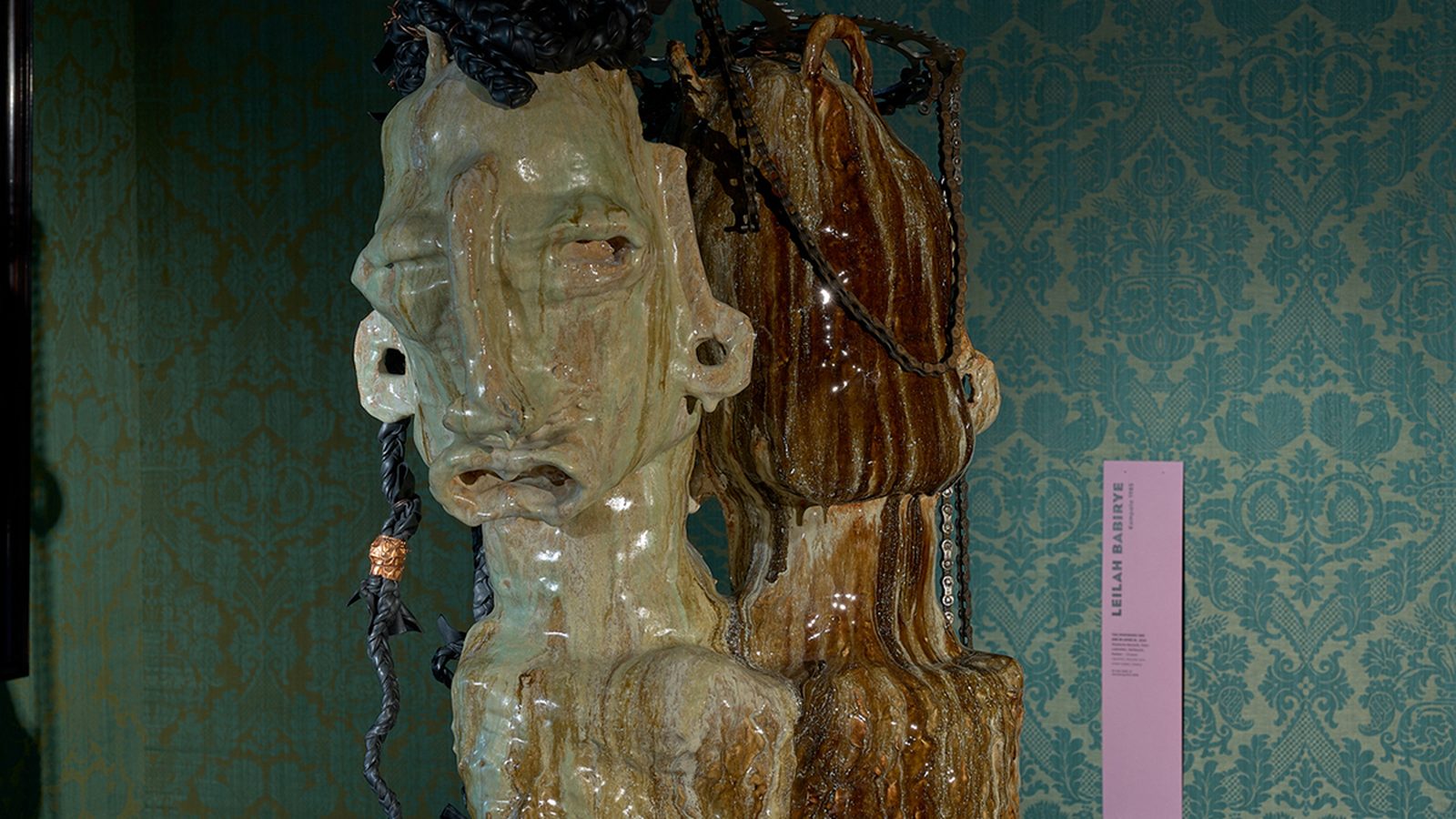
Some artists make work about struggle. Leilah Babirye makes work about joy, royalty, and the right to exist loudly. Born in Kampala, Uganda in 1985, Babirye is a sculptor whose towering figures are built from the very materials most people throw away: bicycle chains, tire inner tubes, salvaged wood, discarded ceramics, and found objects gathered from the streets of New York, where she now lives.
Her story is inseparable from her art. After studying art at Makerere University in Kampala from 2007 to 2010, Babirye was publicly outed as a lesbian by a local newspaper in 2015. She fled Uganda and sought asylum in the United States in 2018. That experience of being named, shamed, and forced to run became the engine of a practice that turns insult into adornment.
Her signature series, Ebisiyaga, takes its name from a Luganda word for sugarcane husk that is also used as a slur against gay people. Babirye reimagines the Kuchu clans of the Buganda Kingdom as monumental kings and queens, dressing her figures in elaborate detail and regal bearing. As she has said: “I am adorning them with beautiful things to show they are more than trash. They are kings and queens.” The trash becomes treasure. The insult becomes a crown.
The art world has taken notice in a major way. In 2024, Babirye debuted at the Venice Biennale, the most prestigious art exhibition on earth, presenting five major sculptures in the 60th edition. That same summer, the de Young Museum in San Francisco mounted “We Have a History,” her first solo museum exhibition in the United States. And right now, through January 18, 2027, the Institute of Contemporary Art in Boston is presenting “Embaga ya Naki ne Naki (Wedding of Naki and Naki),” her first East Coast museum solo show.
That title tells you everything about the project. A wedding. Two brides. Celebrated in a museum, in public, on purpose. Babirye has said: “We also have a life as queer people. Homosexual people can imagine weddings.” In a world where Uganda’s Anti-Homosexuality Act has made queer existence a matter of life and death, imagining a wedding is not a small act. It is the whole point.
What makes Babirye’s work so magnetic is that it refuses the expected script. Queer African art is so often framed through suffering, and the suffering is real. But Babirye insists on something more: glamour, humor, ceremony, size. Her figures are large because her subjects deserve to take up space. They are ornate because dignity is ornate. Her hand-built ceramics and carved, charred wood pieces draw on sculptural traditions from western and central Africa, with closed eyes, elongated necks, and totem-like torsos. Standing in front of one, you do not feel pity. You feel awe. As Babirye has said of her sculptures: “My work represents real people. They have real names. I also believe they breathe. I believe they have scars.”
For a network like ours, Babirye matters for a simple reason. She is proof that Black queer women are not waiting to be given room. They are building the room themselves, out of scrap metal and discarded tires, and inviting everyone to the wedding.
Sources
- https://artafricamagazine.org/embaga-ya-naki-ne-naki/
- https://Ocula.com/magazine/spotlight/the-exhibitions-not-to-miss-this-august-2026/
- https://craftcouncil.org/articles/leilah-babiryes-new-exhibition-is-the-wedding-event-of-the-year/
- https://www.e-flux.com/announcements/6787447/leilah-babiryeembaga-ya-naki-ne-naki-wedding-of-naki-and-naki-cynthia-daignaultvalley-90-years